
Dieter Roth, Basel and Schaulager
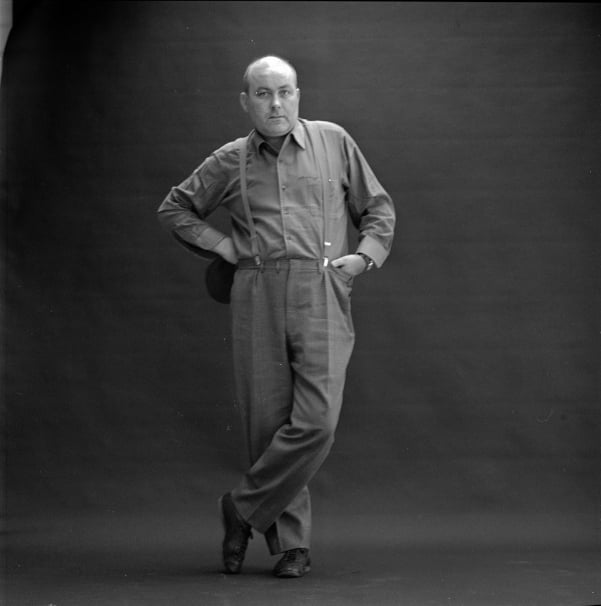
Dieter Roth led a nomadic life, maintaining studios in cities across several countries, permanently arriving and departing. Mentally, however, he remained centered and in close contact with fellow artists, friends and collectors, with whom he sustained strong ties. Roth had numerous connections to Basel. Alongside Hamburg, Stuttgart, Vienna and Reykjavik, Basel was one of his principal centres of activity. Over time, he established one studio, then two, and eventually a third: on Hegenheimerstrasse, Hammerstrasse and in St Johanns-Vorstadt.
Maja Oeri, now president of both the Emanuel Hoffmann Foundation and the Laurenz Foundation (the latter of which operates Schaulager), first met Dieter Roth in the late 1960s at her family home. Her parents used to invite the cast and friends over to celebrate after opening nights at the theatre. After the performance, people would first congregate at the Kunsthalle restaurant, which was the heart of the art scene at the time. And it was practically Roth’s living room: he (p)resided there, eating and drinking with friends, before moving on to the Oeris.
In 1977, Handschin, Roth’s Basel gallery, organized an exhibition. At the time, Felix Handschin and Roth were both in financial straits. To ease their situation, Roth produced hundreds of self-portraits on inexpensive A4 paper although he was actually supposed to be working on his Quadruple Concerto for the Basel Academy of Music. The series of drawings, titled Cash & Carry, was on sale for 300 Swiss francs a piece: only one drawing found a buyer. For Maja Oeri, who was working as an assistant at the gallery at the time, this collaboration marked the beginning of a decades-long friendship with Roth.
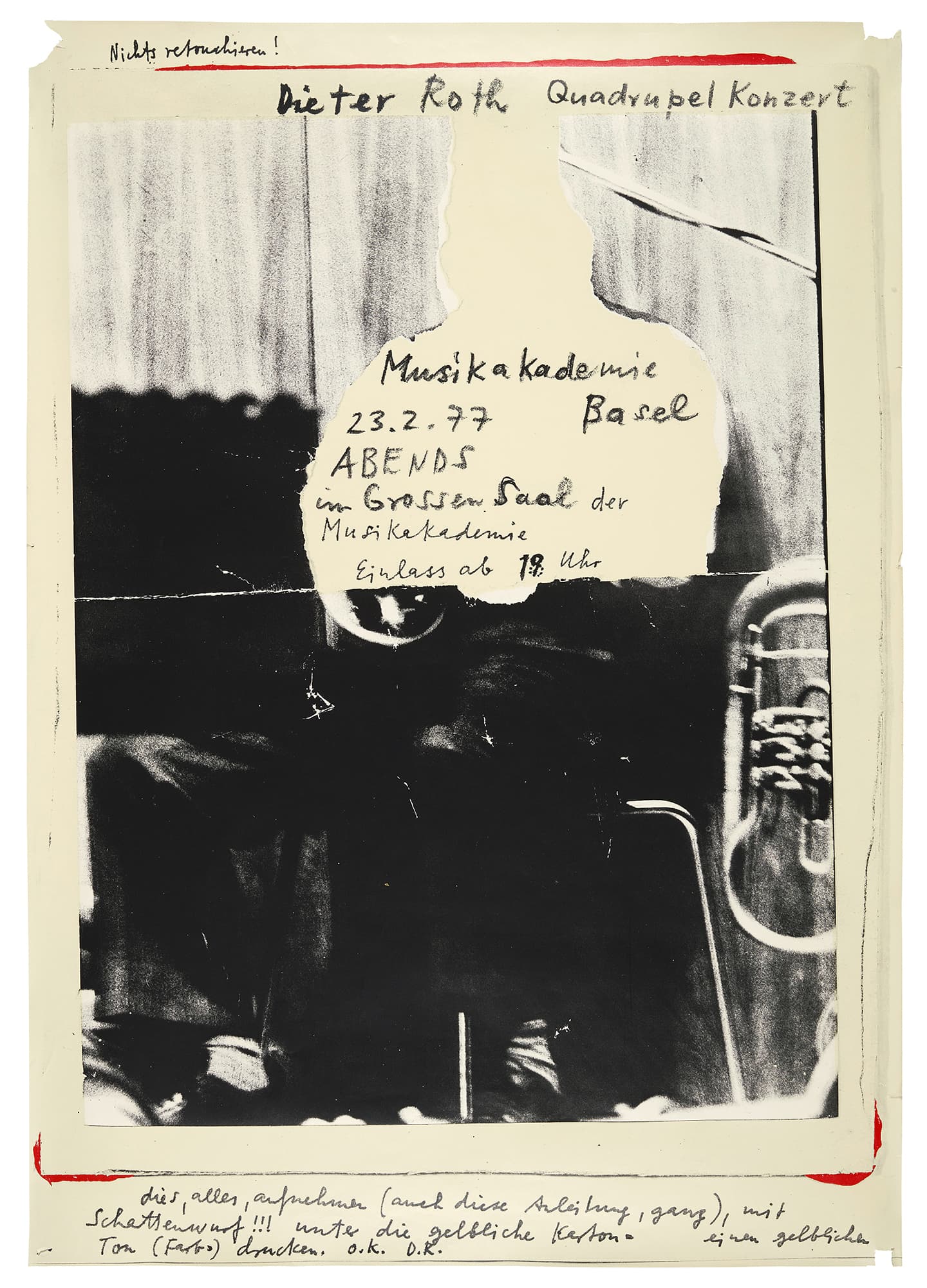
Originalplakat nach einem Entwurf von Dieter Roth (84 × 60 cm). Quadruppel Konzert, 23. Februar 1977, Musik Akademie Basel
In 1982, Roth enjoyed special recognition in Basel: the Johann Wolfgang von Goethe Foundation awarded him the Rembrandt Prize for outstanding achievements in the visual arts. His friend, the artist Emmett Williams, delivered the laudatory speech, after which Roth stepped on stage. Pocketing the gold medal, he waved goodbye to the jury, said “Auf Wiedersehen” to the audience and walked off with a smile, delivering what may have been the shortest acceptance speech in history.
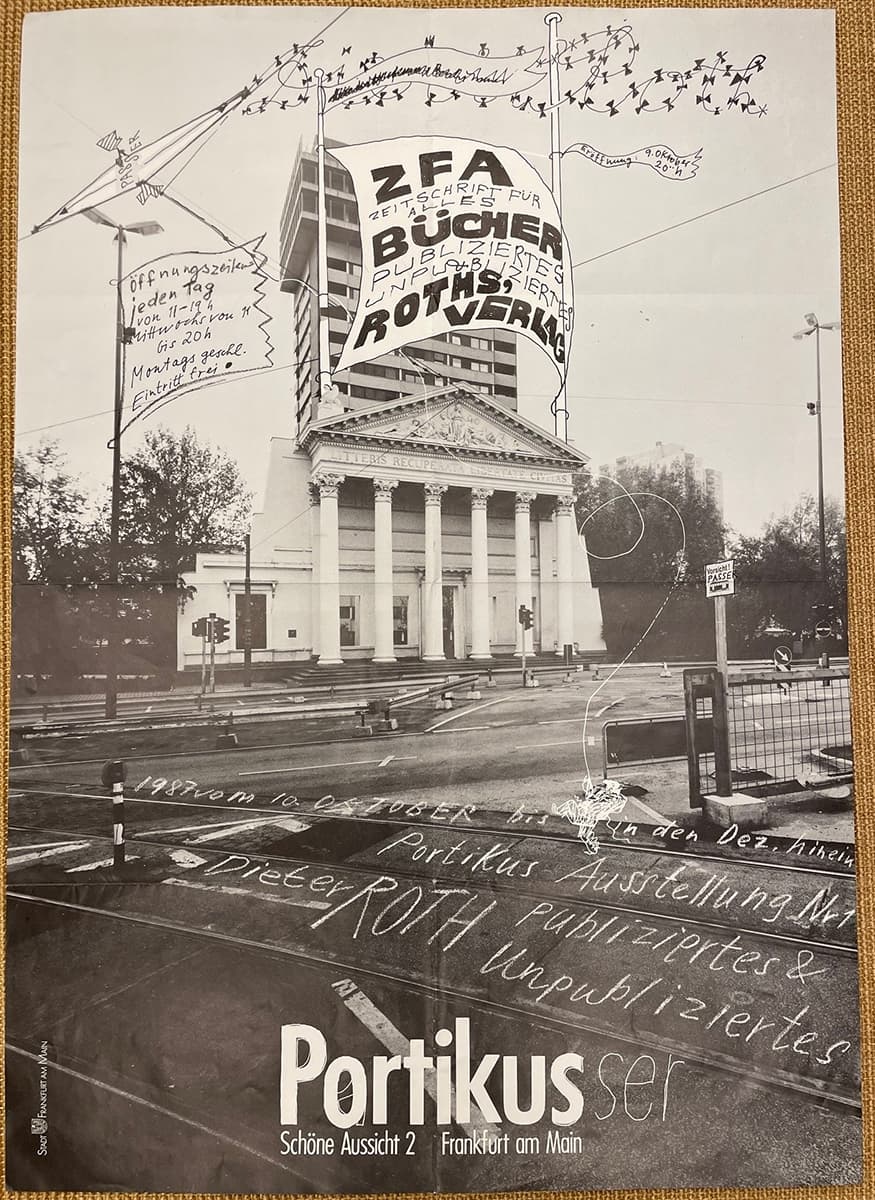
Original-Plakat nach einem Entwurf von Dieter Roth (84 × 60cm). Plakat für die Eröffnungsausstellung im Portikus, Frankfurt, 10. Oktober bis Dezember 1987
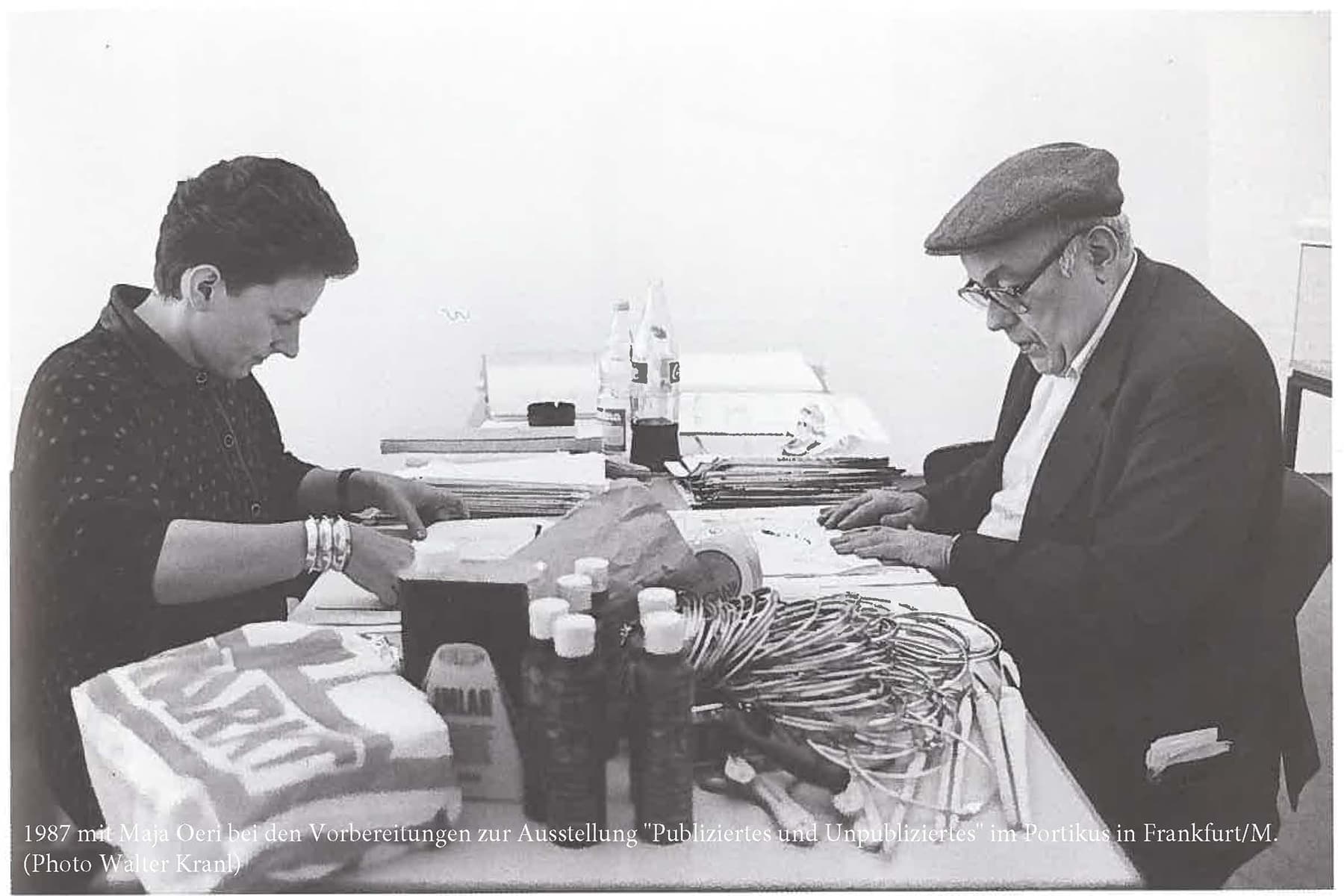
1987 mit Maja Oeri bei den Vorbereitungen zur Ausstellung «Publiziertes und Unpuliziertes» im Portikus in Frankfurt/M.
Maja Oeri was involved in many of Roth’s projects. The artist represented Switzerland at the Venice Biennale in 1982 with A Diary, an installation consisting of 41 Super-8 film projections, which - shown simultaneously - depicted scenes from Roth's own daily life. Thanks to Oeri’s efforts, the curator Kasper König was able to present the installation at the exhibition “Von hier aus – Zwei Monate neue deutsche Kunst in Düsseldorf” (From Here Out – Two Months of New German Art in Düsseldorf) in 1984, for whose catalogue Oeri was responsible. Another collaboration led to “Publiziertes und Unpubliziertes” (Published and Unpublished Works), the inaugural exhibition of Portikus in Frankfurt am Main in 1987.
Oeri also played a key role in acquiring further works by Roth for the Emanuel Hoffmann Foundation, following the first acquisitions in 1971. These included Das Meer, 1. Teil (The Sea, Part 1, 1968), a sculpture composed of stacked bars of chocolate with strips of paper spilling out of it, bearing cryptic typewritten phrases such as “Verrauchen in einem HAUFEN RAUCH” (Going up in a pile of smoke) or “der HAMMEL DER IHM DIE KOTELETTEN” (the ram/jackass, to him the cutlets/sideburns). The structure recalls a clattering, insatiable typewriter endlessly producing text. Or Basel am Rhein (Basel on the Rhine, 1970), a painting made of chocolate, foam and sheet metal. Works held by the Emanuel Hoffmann Foundation are housed at Schaulager unless they are on permanent loan to the Kunstmuseum Basel or otherwise on view in international exhibitions.
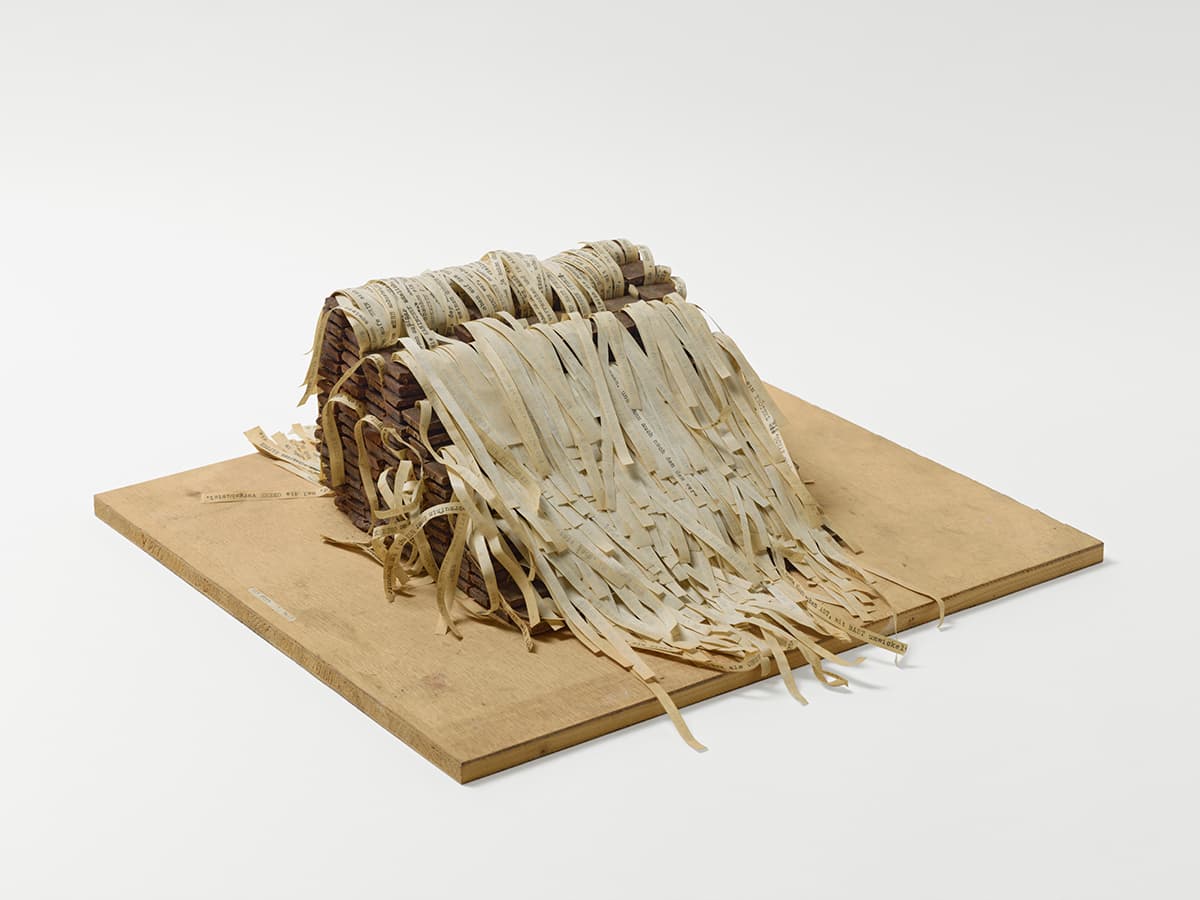
Dieter Roth, Das Meer, 1. Teil, wood, chocolate, strips of paper, 16 × 41.5 × 46 cm, Emanuel Hoffmann Foundation, on permanent loan to the Öffentliche Kunstsammlung Basel, photo: Bisig & Bayer, Basel, © Dieter Roth Estate, Courtesy Hauser & Wirth
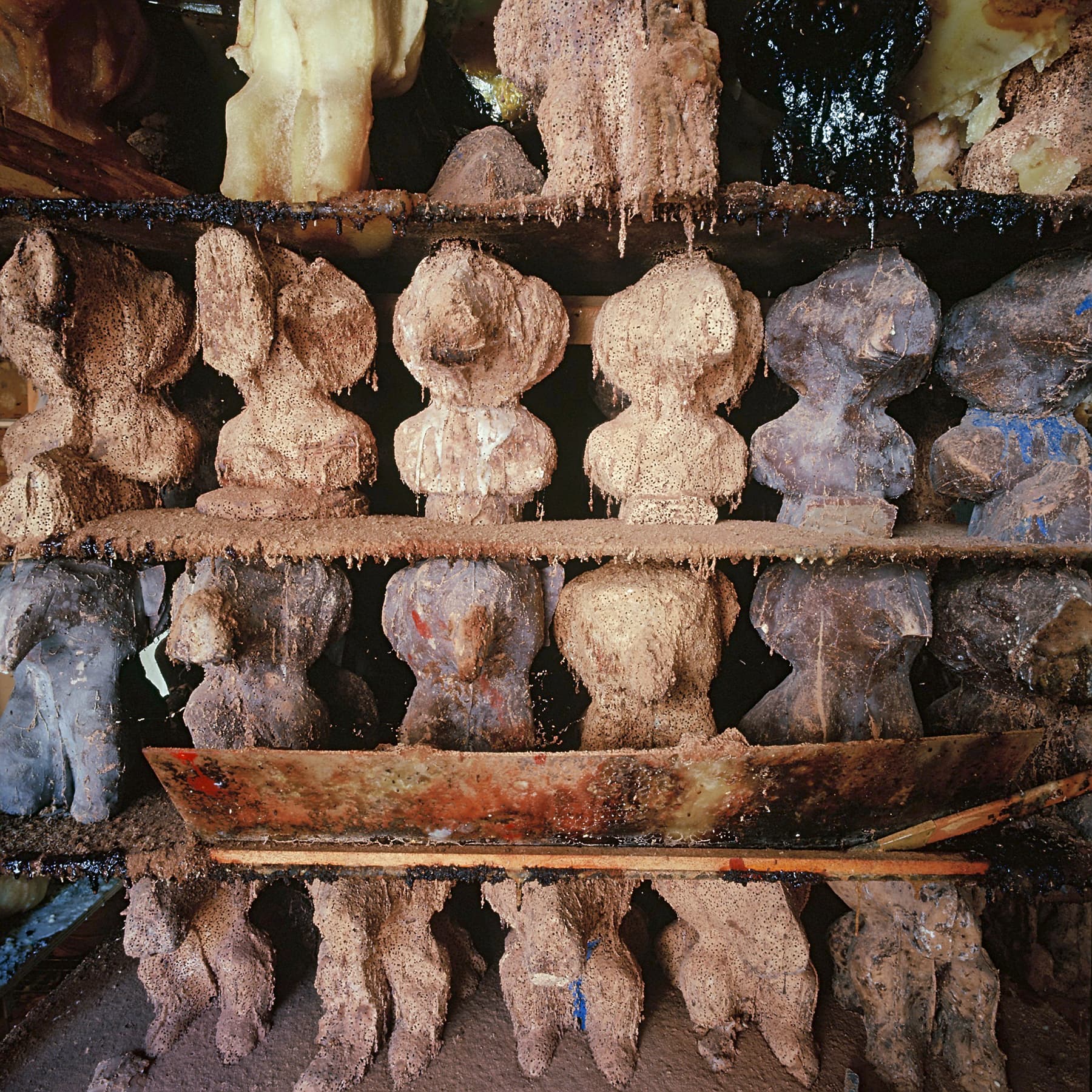
Dieter Roth, Selbstturm/Löwenturm, 1969-1998 (Detail Löwenturm)
Selbstturm, 1969-1998, Holz, Glas, Gussfiguren aus Schokolade und Zucker; Löwenturm, 1970-1998, Eisen, Glas, Gussfiguren aus Schokolade und Zucker; Atelierraum bestehend aus diversen Materialien, Objekten und Geräten, Emanuel Hoffmann-Stiftung, Depositum in der Öffentlichen Kunstsammlung Basel (Standort St. Alban-Rheinweg/Basel), photo: Tom Bisig, Basel
In 1989, at the initiative of Maja Oeri, the Foundation acquired Roth’s installation Selbstturm; Löwenturm (Self Tower; Lion Tower, 1969–1998), two free-standing towers of figures cast in colored sugar and intensely fragrant chocolate – hybrids of self-portraits and lion portraits. They are lined up on glass shelves, one above the other, rising like a monument on the verge of collapse. The work defies conventional museum practice: it is not only incomplete but is also subject to constant transformation through the natural decay of its materials. At the time of acquisition, it was still a work in progress, and the artist was only willing to sell it because the Foundation suggested renting a space outside the museum where Roth could continue working on it – a studio accessible to the public, as it still is today.
In 2003, the Schaulager, founded by the Laurenz Foundation, opened with “Roth Time: A Dieter Roth Retrospective”. This exhibition revealed the extraordinary breadth of this remarkably versatile artist’s oeuvre. It demonstrated the groundbreaking influence of Roth’s work on the development of art in recent decades, testifying to its undiminished relevance – not least in regard to his striking literary production. Schaulager’s reference library holds a substantial body of his experimental artists’ and children’s books in addition to his poetry and prose, much of which is now rare and long out of print. The publications can be consulted in the reading room.