• Visit
    • Opening Hours
    • Directions
    • Guided Tours
      • Art education Collection
      • Schaulager Tour
      • Dieter Roth Room
    • Research Visit
      • Research Visits
      • Library
    • Accessibility
    • Photo & Video Regulations
  • Schaulager
    • Architecture
      • Schaulager
      • Extension Building
    • Concept
      • Storage
    • Collection
      • Works
      • Kunstmuseum Basel
      • Foundation Board
    • Research & Projects
      • Méta-Harmonie II
      • Dieter Roth
    • Videos
    • Laurenz Foundation
      • Support
      • Projects
  • Exhibitions
    • Preview
    • Permanent Installations
    • Previous
  • Calendar
  • Bookstore
  • Videos
  • Media
  • Search
  • Contact
  • Deutsch
  • English
  • DE
  • EN
  • Videos
  • Media
  • Visit
  • Schaulager
  • Exhibitions
  • Calendar
  • Bookstore
  • Preview
  • Permanent Installations
  • Previous
  1. Home
  2. Exhibitions
  3. Dieter Roth
  4. Dieter Roth at Schaulager


Dieter Roth at Schaulager


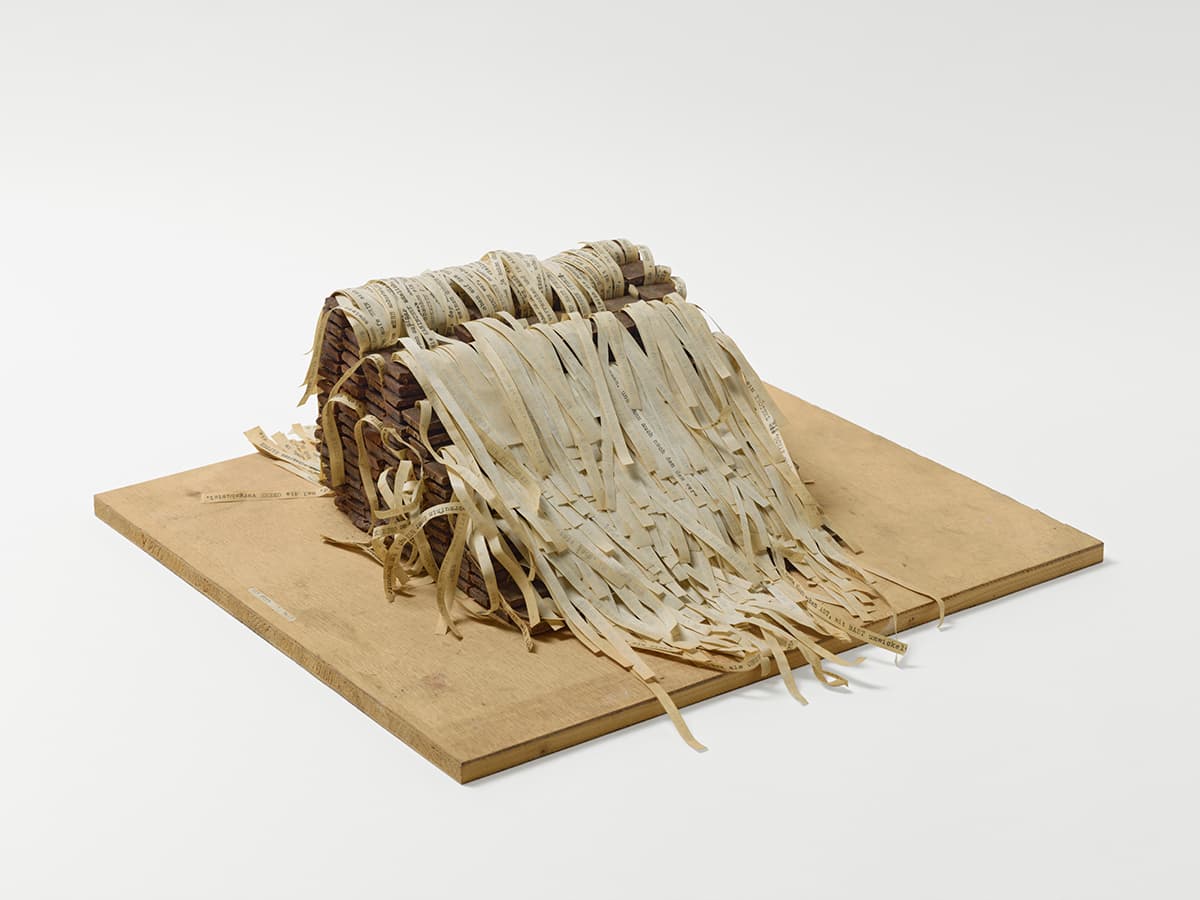
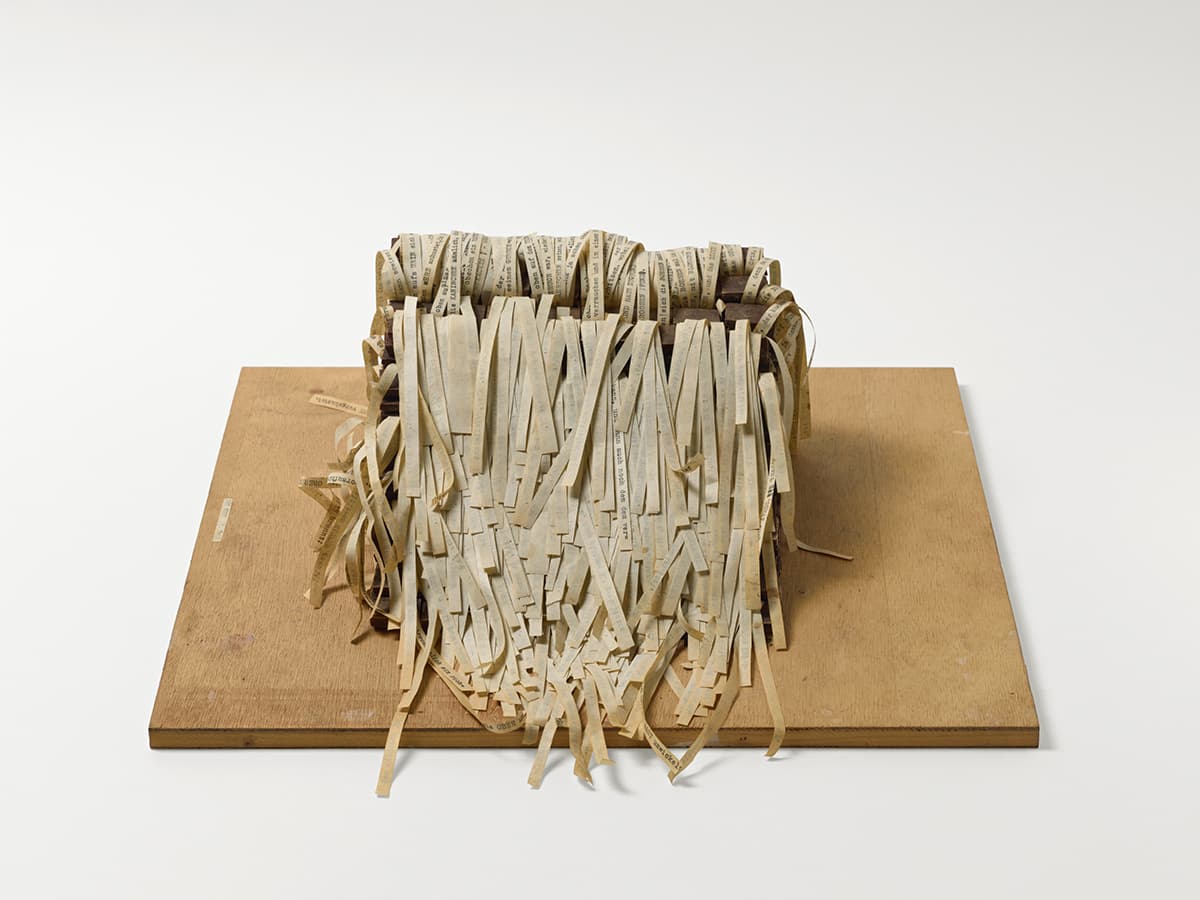
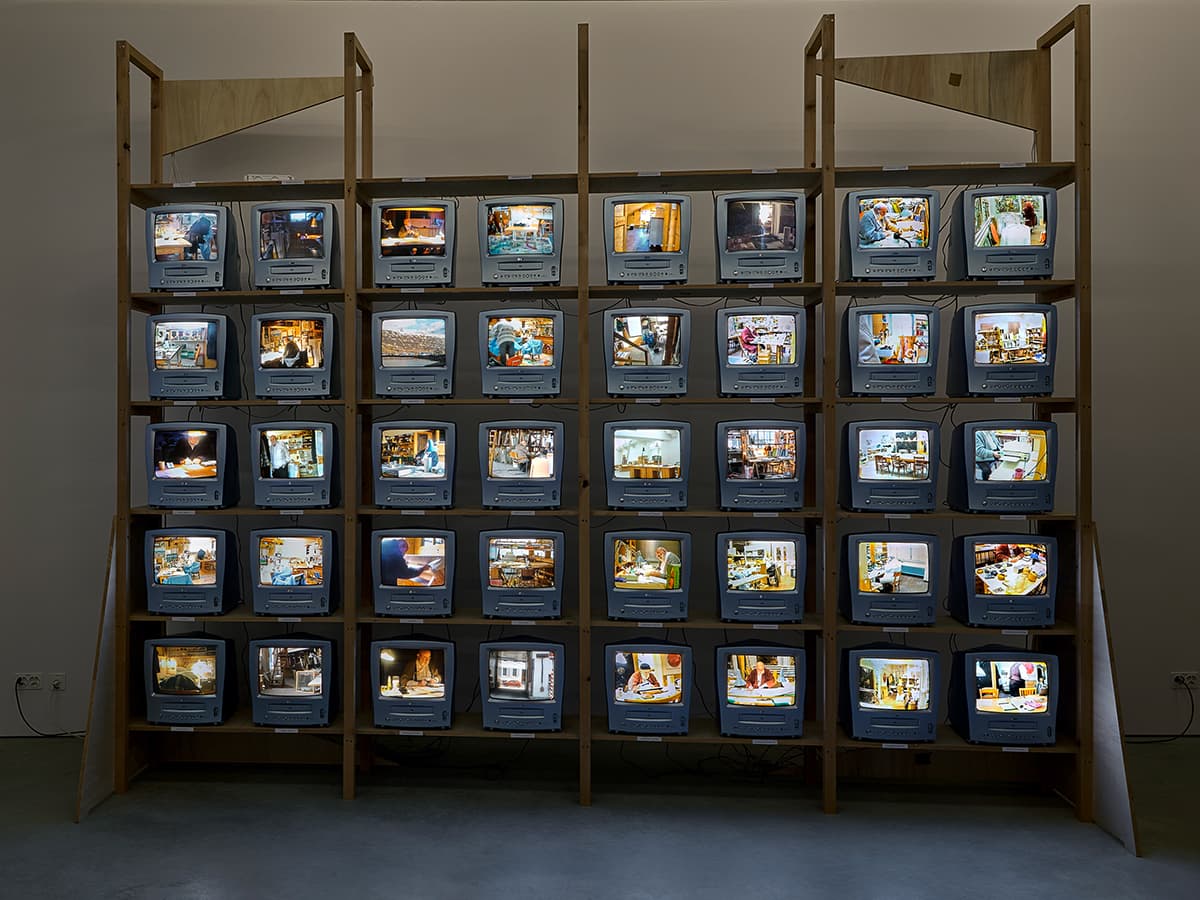
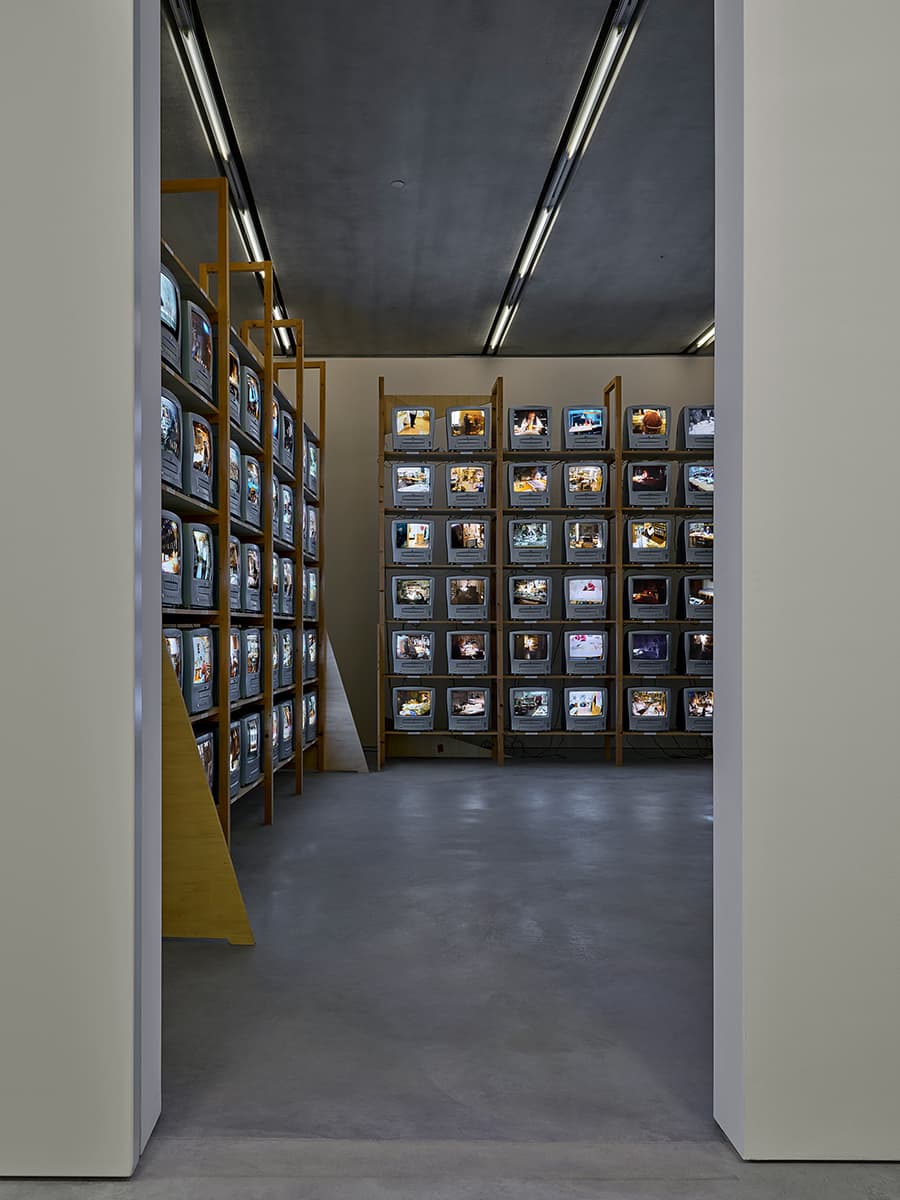
At the Schaulager, several significant works by Dieter Roth are on display. These include Solo Szenen (Solo Scenes, 1997–1998), a video installation composed of 128 monitors arranged on shelving units; Ringgebilde (Ring Configuration, 1986–1993), a structure assembled from countless objects; and Das Meer (The Sea, 1970), a material assemblage made of layered chocolate bars and labeled paper notes.

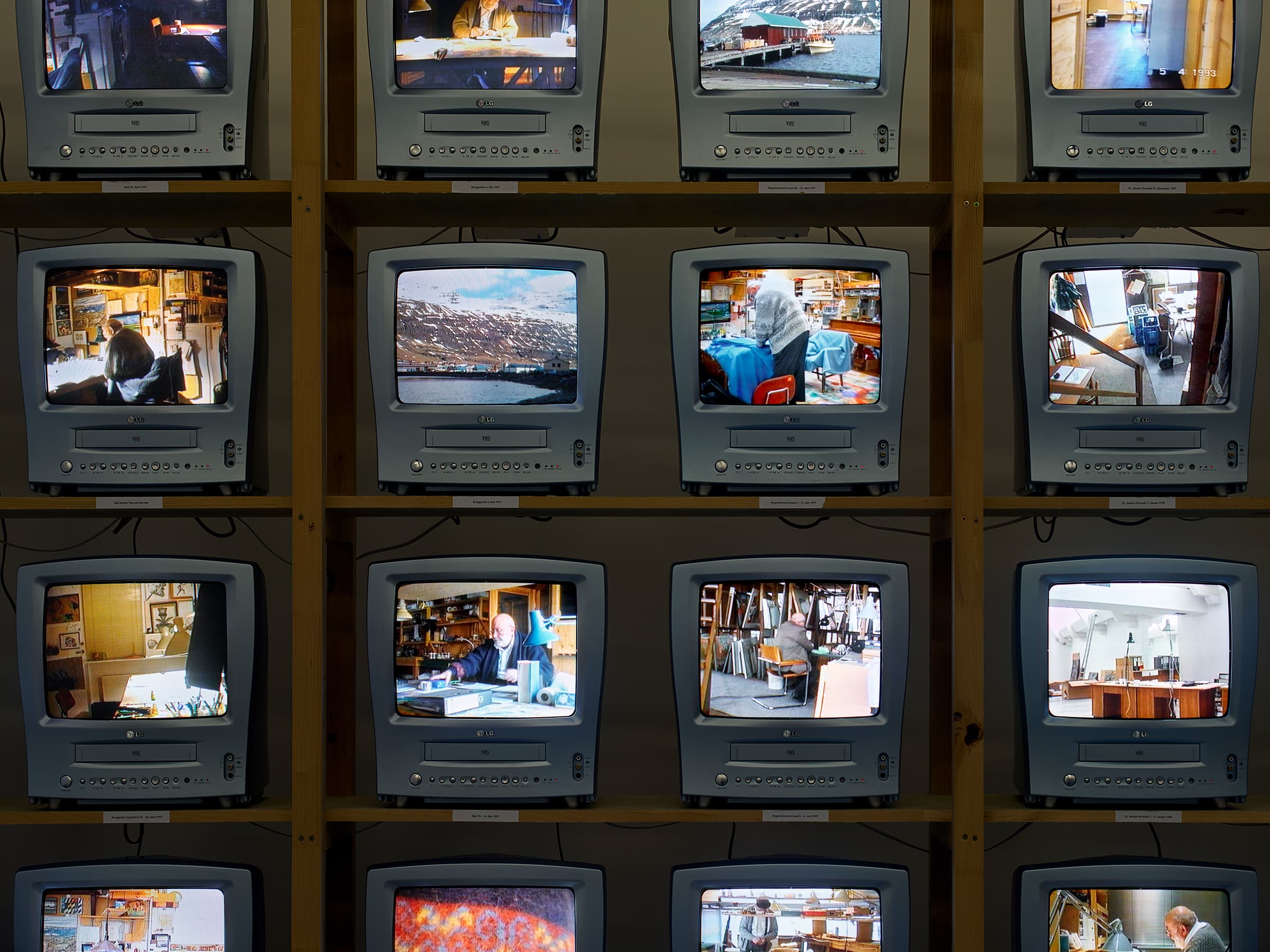
Solo Szenen (1997–1998)

Dieter Roth, Solo Szenen, 1997–1998, 128 video monitors with players, 3 wooden racks, 128 VHS video tapes, 2 shelves, approx. 1200 × 210 × 45 cm overall, Emanuel Hoffmann Foundation, gift of the president 2023, on permanent loan to the Öffentliche Kunstsammlung Basel, photo: Tom Bisig, Basel, © Dieter Roth Estate

A rack with three shelves that looks like an oversized wall unit contains no fewer than 128 monitors. The integrated VHS players do not show the daily news or soap operas but rather intimate glimpses of Dieter Roth’s ordinary life. We see him reading and sleeping, sitting at his desk doing nothing, writing, naked in the shower, on the toilet. This kaleidoscopic self-surveillance of the aging artist’s daily life is, as Roth pragmatically argues, a time-saving form of documentation. Solo Szenen was meant to be Roth’s legacy; he died in June 1998, before the work premiered at the Venice Biennale.

The self, the ego, and aging have long been a concern for this universal artist, as illustrated by P.O.TH.A.A.VFB. Roth was 38 when he exposed himself to gradual decay as an aging man in his Portrait of the Artist as Vogelfutterbüste, a cast object in an edition of 30 copies, made out of milk chocolate and bird feed. The title of the work, which he modified several times, alludes to James Joyce’s novel Portrait of the Artist as a Young Man, which Roth considered to be kitsch. His aversion to artificiality and histrionics as well as performances on TV motivated Solo Szenen. Lying in bed awake, restlessly active, watching television, he was, in fact, so enervated by what he saw that he decided to create an alternative to the artificial reality on screen by filming his unembellished daily life as is. However, Solo Szenen not only testifies to Roth’s battle with addictive television; having fought alcoholism and depression for some time, he had just managed to pull himself together and concentrate on a project. He had to go through this critical phase alone, solo. Solo Szenen is essentially the sequel to A Diary (1982), Roth’s first contribution to the Venice Biennale. It, too, is a consecutive series of films that subverts the art public’s expectations of the eternally creative artist. He filmed Solo Szenen in Iceland, Hamburg, and Basel.

The country in the far north had been his lifelong homeport. Having fallen in love as a young man, he moved there and started a family. He wanted to be a vital and above all sober grandfather to his grandchildren; he found peace and a sense of balance in Iceland. Born in Hanover in 1930, the artist led a lifelong nomadic existence. At the age of 14, he was sent to Switzerland to live with a foster family during the Second World War, after which he traveled via Denmark to Iceland. Following several stays in the United States, he set up studios in such cities as Vienna, Hamburg, and Stuttgart, also living in them at times. He actually had three studios in Basel and even a fourth space next to the Kunstmuseum Basel | Gegenwart where Selbstturm; Löwenturm has been installed since 1990. P.O.TH.A.A.VFB. was the predecessor of the monumental installation with its two imposing towers containing busts of chocolate and sugar. The Emanuel Hoffmann Foundation acquired Selbstturm; Löwenturm as a work in progress and, like Solo Szenen, its ongoing development came to a halt when the artist died.
Ringgebilde (1986–1993)


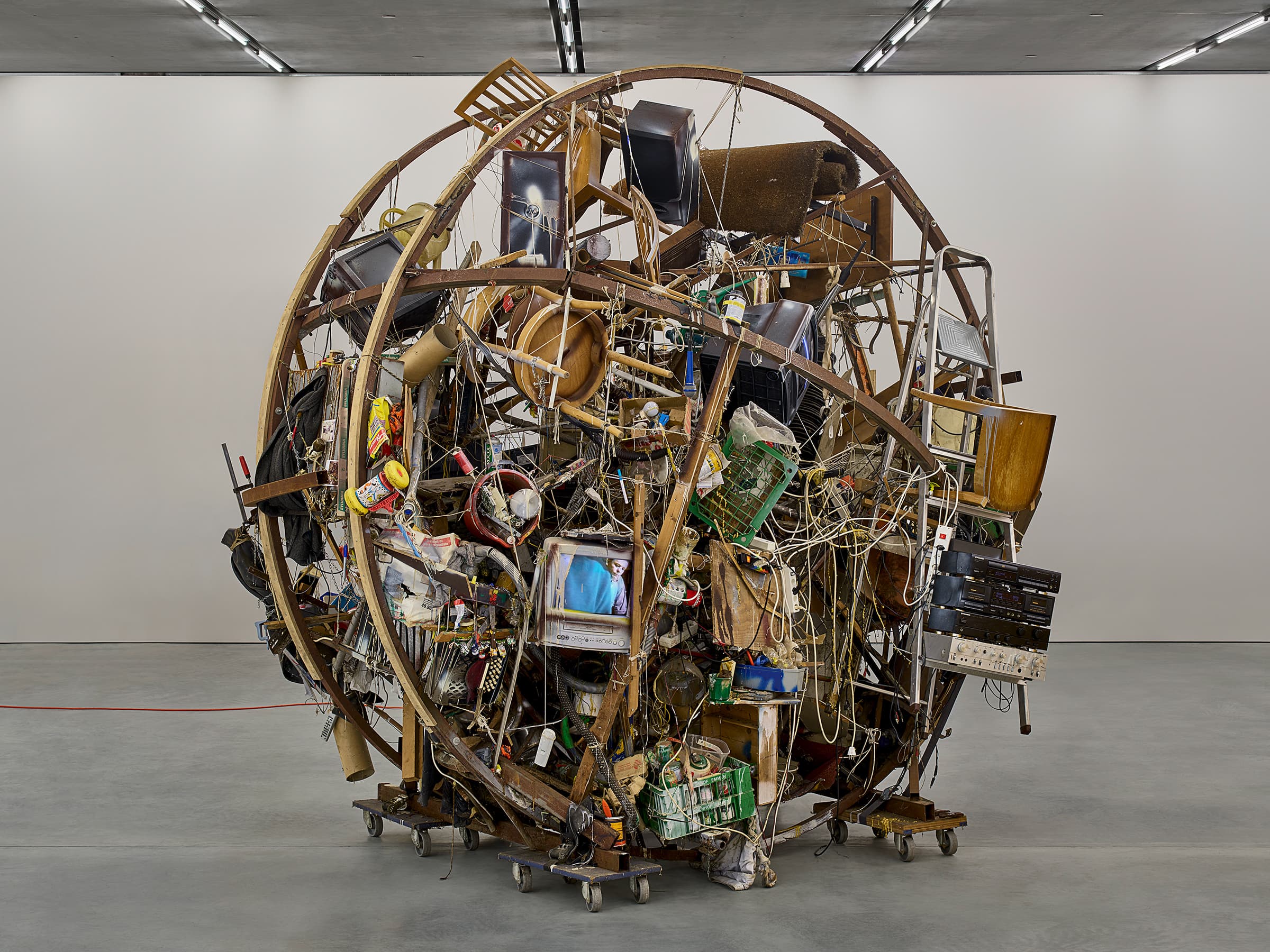
Look how you will at the cornucopian complexity of Dieter Roth‘s Ringgebilde (Ring Configurations, 1986–1993), you cannot escape being drawn into a chaotically entangled jumble of everyday objects, piled up helter-skelter in a ring-shaped structure. Household appliances, musical instruments, abandoned toys, cigarette butts, numerous buckets of pencils some meticulously sorted by color, painters’ paraphernalia, chairs, carpets, socks, clothing, smocks and tubes or pots of Cementit or Ponal adhesive keep company with fully functional electrical devices like vacuum cleaners, tape recorders, DVD players, amplifiers, speakers, video players, and monitors.

An array of cords, chains, cables, metal pipes, and nailed or screwed wooden slats ensures the stability and inscrutable balance of this domestic hodgepodge. The whole rests on four dollies so that it can be moved about in space. Experimenting with the limits of stability and instability, pushing the latter to extremes and even beyond, was a driving force throughout Dieter Roth’s life and work.

Some of the objects in the Ringgebilde seem like traces of memory that hark back to Roth’s childhood. The accordion, for instance: to ensure his safety during the Second World War, he had been sent from Hanover to Switzerland in 1941, and his host family had given him such an instrument. However, most of these objects testify to the immediacy of the moment during the several years spent assembling the work in his studio; it was a work-in-progress made in collaboration with his son Björn Roth, Gisli Jóhannsson, Pétur Kristjánsson, and others.

It is not only the impenetrable thicket of the Ringgebilde that undermines a reliable perspective; an auditory factor comes into play as well. At times, we hear the drone of a machine or music when a vacuum cleaner, a monitor, or a sound system is switched on, for instance, Billie Holiday singing All of Me. Holiday was one of the greatest but also most tragic jazz singers of all time. She was just forty-four when she died from liver cirrhosis and drug abuse, penniless and under police surveillance—but not without leaving behind unforgettable jazz classics rendered in her inimitable style. Regarding the emotional impact of her singing, she once remarked, “I have lived these songs,” prefiguring Dieter Roth’s lifelong commitment to his art.

The impact of this soundscape, at times murmuring, at times monotonously loud, is such that we are inevitably transported into the industrious atmosphere of an artist’s studio. A curious sense of presence and timeless oblivion sets in; it is as if Dieter Roth could come walking in any moment to casually continue making adjustments to his Ringgebilde.

In the artist’s oeuvre, the Ringgebilde is just one of many gigantic, material assemblages, which kept evolving and expanding over the years. In the 1970s, in his studios in Switzerland, Germany, and Iceland—they were at once art space, refuge, and living quarters—Roth started making works over long periods of time, adding ever-increasing quantities of material in a celebration of disorder and profusion: iconic works such as Flacher Abfall (Flat Waste, 1975-1976), Gartenskulptur (Garden Sculpture,1970–1998), or Selbsturm; Löwenturm (Self Tower; Lion Tower, 1969/1970–1998). These works testify to his relentless and yet self-ironic investigation of the entropic catastrophes that marked his lifelong pursuit of self, identity, and non-identity.

Readily sinking into the bottomless pit of daily ritual and reality, the Ringgebilde joins the ranks of numerous works that embody Roth’s never ending parable: the dynamics of the gradual making of art in life or of life in art. Here, everything is of equal value; a Sisyphean equality, for there is nothing that cannot be plucked out of the circular treadmill of daily life to be artistically revalued, and vice versa. Roth has undone the distinction between life and art, once and for all.

The Ringgebilde was shown in Roth’s major 1992 exhibition at Holderbank and in 1995 at the Wiener Sezession. The two exhibitions are among the most important presentations of his oeuvre to be organized in his lifetime. It was also on view in the posthumous retrospective Roth Time, Schaulager’s inaugural exhibition in 2003.

Das Meer (1970)

Das Meer, 1. Teil

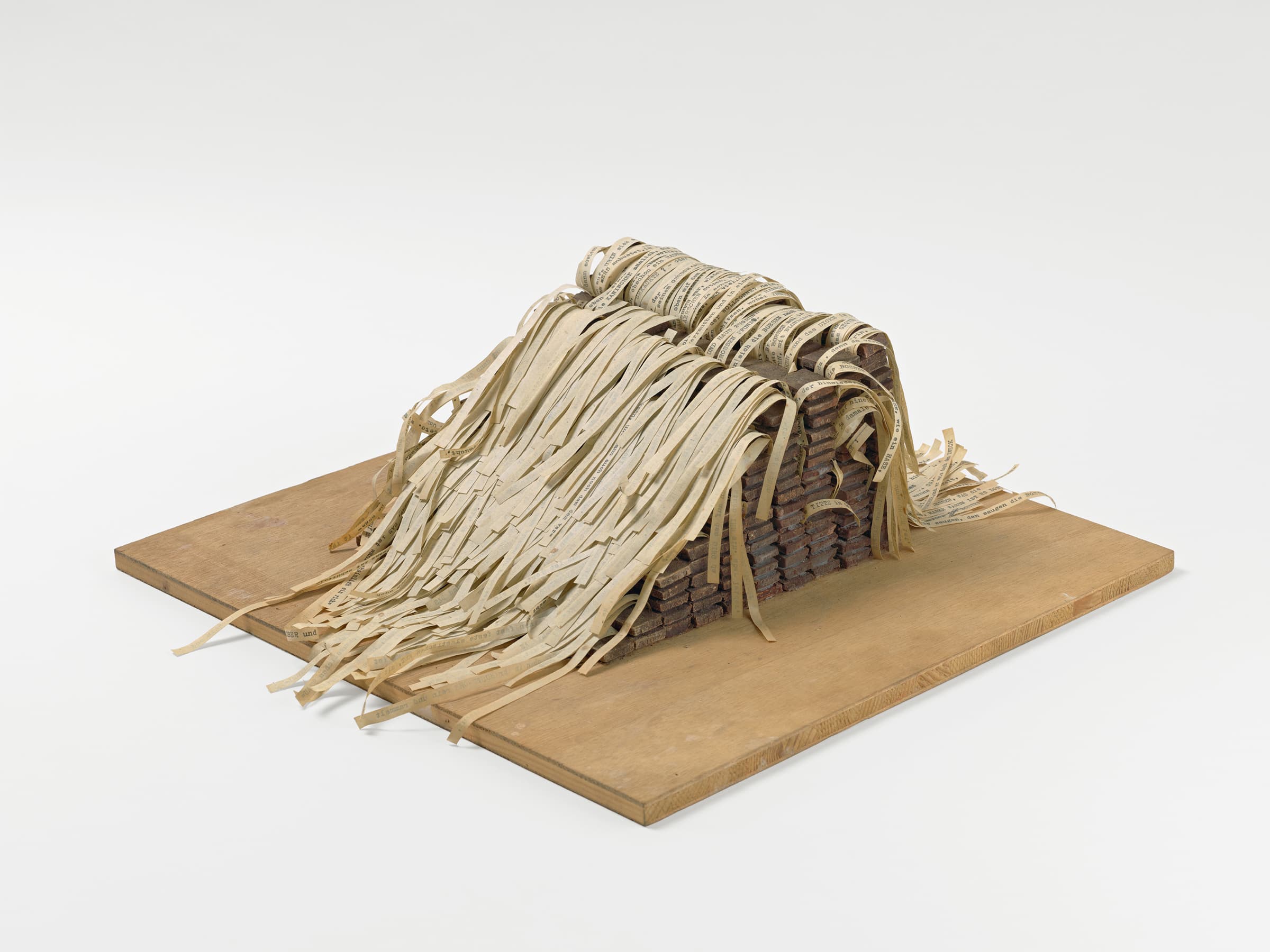
Perplexing phrases such as “Verrauchen in einem HAUFEN RAUCH” (Going up in a puff of smoke) or “der HAMMEL, DER IHM die KOTELLETEN” (The ram/jackass, to him the cutlets/sideburns) are typed on endless, narrow strips of paper that seem to be spilling out of a sculpture made from stacked bars of chocolate. The title of the sculpture, Das Meer, 1. Teil (1968) (The Sea, Part 1), immediately calls to mind associations with a wave on the point of breaking. But the sight of it is also reminiscent of a rattling, ever-hungry typewriter that is incessantly spewing out texts without ever being able to order or halt them. The format, materials and the incorporation of language convey a sense of the processes, the bifurcations and the ramifications that were typical of Dieter Roth's unbridled creativity. The word Meer in the title, which means “sea” but also sounds the same as “mehr” – meaning “more” – reappears a few years later in the cycle Das Tränenmeer (The sea of tears; 1971–1979), a literary project revolving around sentences such as “Ausgeweint ist ausgeschlafen” (A good cry is a good night's sleep) which he published as small ads in the Luzerner Stadtanzeiger in 1971/1972. For the purpose of this sculpture Roth had cut up a novella, entitled “ein RAUCHER, das GERUMPEL ... ”, that he had written for the Basel harpsichordist and collector Antoinette Vischer, only to find that it was of no interest to her. The extended poem and the chocolate became the basis of the sculpture.

With this hybrid coupling of foodstuff and text Roth recalled the artist's books – the “Literaturwürste” (Literature sausages) – that he had been making since 1961. In his own form of ironic literary criticism Roth took books by Günter Grass, Max Frisch, Martin Walser and Heinrich Böll, or publications such as the German magazine Der Spiegel and the British newspaper the Daily Mirror, cut them up into small pieces and then, following traditional recipes, added fat, gelatine and spiee to turn them into “sausages” – such as “Mexikanische Kleinschweinwurst” (Mexican small pig sausages) or “Italienische Pfefferwurst” (Italian pepper sausages). Das Meer, 1. Teil brings together Roth's own development of Concrete poetry and the pataphysically inspired Gruppe Oulipo (Uüuvroir de Litterature Potentielle) with the temporalit and material decay of his later works. Besides the work in the collection, there are three other wave-like works combining written texts and chocolate: Das Meer (1968), Die Geschichte (Das Geschichtete) (1968) and Schokoladenmeer (1970).


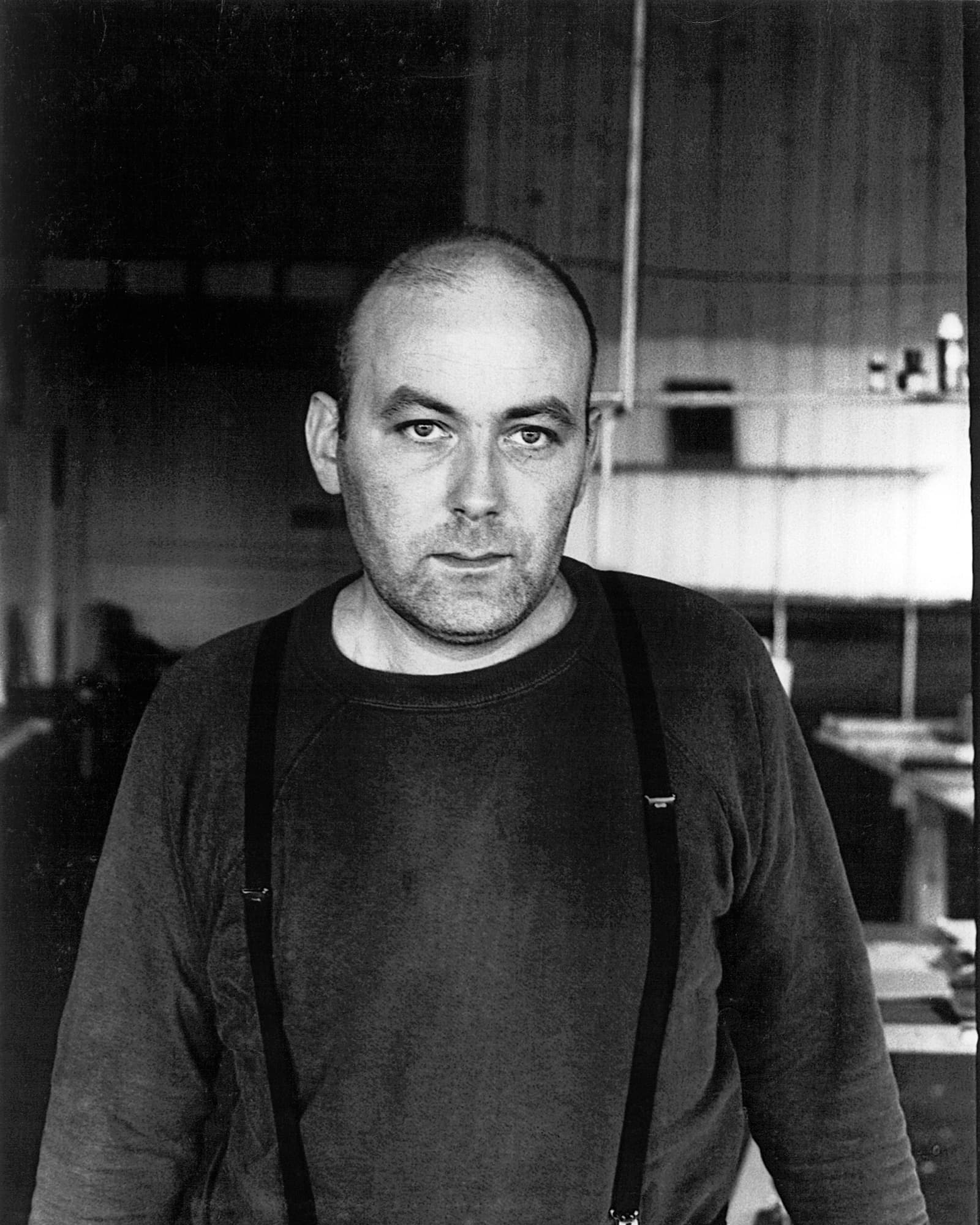
Dieter Roth (b. 1930, Hanover, Germany, d. 1998 Basel, Switzerland) was sent away from Hanover to live with a foster family in Zurich at the height of the Second World War. After an apprenticeship as a graphic artist in Bern (1947–1951), he emigrated to Iceland in 1957, where he got married and established a family. Roth was a restless soul; he not only lived in a variety of countries but also worked in a variety of media – he painted, wrote, pulled prints, took pictures, drew, wrote, made sculptures, produced multiples, designed jewelry, collaborated with other artists, and made music. From 1960 onwards, he worked and exhibited in the USA (e.g., Philadelphia, Providence, and New York) and in Europe (e.g., Stuttgart, Vienna, London, Basel, and Hamburg). In the 1980s, Switzerland became his preferred place of residence, but he always returned periodically to his family and places of work in Iceland.

Dieter Roth in Providence, Rhode Island, ca. 1965.
Photo: Lisa Redling

  • About us
  • Opening hours
  • Directions
  • Contact
  • Laurenz Foundation
  • Concept
  • Architecture
  • Research
  • Reseach enquiries
  • Research visit
  • Requests for images
  • Library
  • Media
  • What's on
  • Schaulager
  • Archive
  • What's on
  • Dieter Roth
  • Calendar
  • Archive
  • Exhibition archive
  • Video archive
  • Bookstore
  • Shop online
  • Newsletter
  • Register
Schaulager, Ruchfeldstrasse 19, 4142 Münchenstein
T +41 61 335 32 32, F +41 61 335 32 30, info@schaulager.org
  • Credits and legal notice
  • Terms and conditions
  • Search
  • Privacy Policy
© 2026 Laurenz-Stiftung, Schaulager. All rights reserved.